|
A Basic Mechanical Watch |
|
|
|
|
|
|
||
|
|
|
|
|
|
||
|
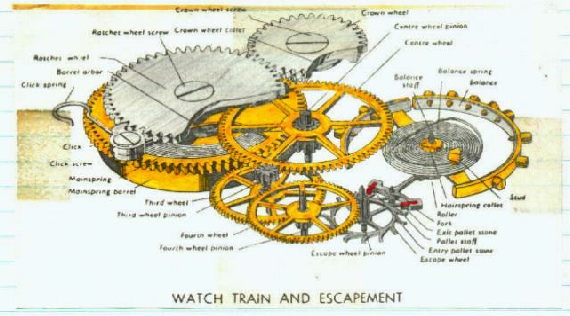
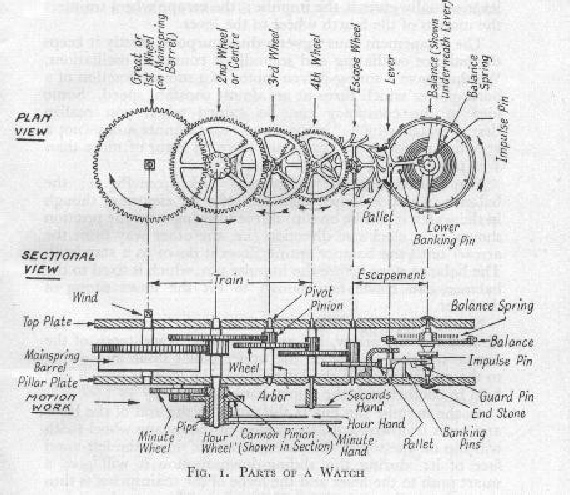
The Train. As will be seen from the diagram a train is simply a series of toothed wheels and pinions connected together so as to transmit power: on the left is the great wheel which, in most watches, forms part of a shallow box or barrel in which is coiled a ribbon of steel. This is the mainspring which is wound up by hand and in uncoiling turns the great wheel. This wheel usually turns once in about 7.5 hours, and gears with a pinion the second, or centre wheel: this, of course goes round once an hour. Two other wheels, the third and fourth, follow in the same way, the latter going round once a minute if there is to be a seconds hand. The wheels are of thin hard brass and the pinions of hardened and tempered polished steel, and the more exactly the teeth are cut and the wheels and pivots are fitted, the more power will reach the fourth wheel. Since the fourth wheel is geared up from the first wheel in the proportion of about 450 to 1, and since a lot of power is used up in unavoidable friction, you can see that the force turning the fourth wheel is very small indeed. So much so that when a watch stops through dirt in the teeth it is usually in this wheel you will find the offending hair or grain of sand. In the diagram the train is shown for clearness in a straight line, but in most watches it wanders about in all manner of curves, in some cases doubling back on itself so that one wheel comes completely on top of another. Nevertheless in any mormal watch you should, by this diagram, be able to identify these four wheels with certainty. The Escapement This is really the governor referred to above and which "keeps time." The lever movement shown in the diagram consists of escape wheel, lever, balance and balance spring. The real heart of the escapement is the balance and its spring; imagine for a moment that all the rest of the wheels and the lever are removed, and the balance is at rest in mid-position. Now imagine it is moved through say 90 degrees in a clockwise direction, thus slightly winding up the balance spring, and then let go. The spring will pull the balance back to its original postion, but, having reached this position, the balance is travelling quite fast, and overshoots the mark. If it were not for friction it would overshoot to the extent of 90 degrees anti-clockwise, i.e. the other side of mid-position, and unwinding the balance spring by the same amount as it had formerly been wound up. Then the wheel stops, but only momentarily: the spring pulls it back, and so it goes on, first one way and then the other until finally friction slows it down to rest. The wonderful thing about this balance and spring is that the time it takes to pass form mid-position to end of its swing and reach it again on the return is very, very nearly constant irrespective of whether it swings a short arc or a long arc. It is this tiny fraction of time that is added up and read by the hands moving over the dial. In order to keep the balance swinging, it is necessary to give it a push now and again: some wtahces, such as the chronometer and duplex give it a push (or impulse) while the balance is travelling in one direction only, while others, such as the lever give it an impulse every time it passes mid-position, alternately one way and the other. The lever actually gives it the impulse; the escape wheel transfers the motion of the fourth wheel to the lever. The escapement thus serves a dual purpose: firstly it keeps the balance oscillating and secondly it counts its oscillations. We thus have a spring-driven motor of a minute fraction of a horse-power (or equivalents) which turns at an almost constant speed. Some idea of the constancy can be gained when you realise that a watch which "keeps time" to 1 minute a day (not a very fine performance in this day and age) must not have an error of more than 1 in 1440. Another view of the watch train and escapement. The underlined Working Jewels is a link to another webpage on this site to explain the basics of jewelling in a watch movement. Working Jewels |
|
|
||
|
|
|
|
|
|
||